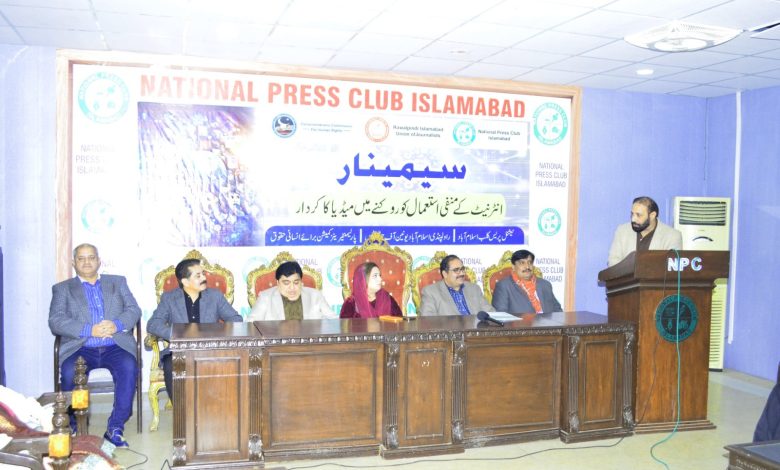
The Rawalpindi Islamabad Union of Journalists, the National Press Club and the Parliamentarians Commission for Human Rights convened a seminar at the Islamabad Press Club to address the role of digital media in stopping the spread of harmful online content. The event brought together senior journalists, media experts, legal professionals and students for practical training on fact checking and responsible reporting.
Shazia Rizwan, Parliamentary Secretary for Information and Culture and guest of honour, praised journalism as a sacred profession and stressed the importance of promoting constructive thinking across digital platforms. She said sincere efforts bear fruit and highlighted the need to steer digital media discourse in a positive direction.
Khil Das, Minister of State, described the Press Club as his home and noted how modern technology has transformed journalistic methods. He urged colleagues to tolerate criticism while insisting on fact‑based reporting, and observed that despite the rapid spread of fake news, improved digital systems can help reduce corruption.
Afzal Butt, president of the Pakistan Federal Union of Journalists, called on reporters to adapt to changing circumstances and master the tools of the new era. He warned that disinformation is often circulated intentionally and stressed that digital media must be used to reflect society accurately rather than to amplify false narratives.
Tariq Ali Wark, president of the Rawalpindi Islamabad Union of Journalists, said digital media is an unavoidable reality and that journalists must gain proficiency in its tools. National Press Club president Azhar Jatoi urged constant learning to keep pace with rapid change, while secretary Neer Ali linked the future of modern journalism directly to digital media and called for a united effort to eliminate fake news.
Speakers also included Chaudhry Shafiq, CEO of the Parliamentarians Commission for Human Rights, former PFUJ secretary Nasir Zaidi, PRA secretary Chaudhry Naveed Akbar, Kashmir Bar Council chairman Tariq Bashir and Asad Baig, who warned that uncontrolled digital spread threatens social harmony and journalistic responsibilities. A number of senior journalists and office bearers from both unions participated, including Raja Bashir Usmani, Ehtesham ul Haq, Ali Akhtar Ghaffran Chishti, Aamir Sajad, Syed Abid Abbasi, Saghir Chaudhry and Rana Adnan.
The workshop provided hands‑on sessions on modern media trends, digital fact checking and security, and emphasized that speed of news in the social media era must not trump verification. Participants were trained in practical techniques to detect fake videos and unverified reports, and were reminded that the media’s role extends beyond reporting facts to guiding the public responsibly.
Speakers encouraged young journalists to develop skills in investigative reporting, digital security and professional ethics so they can counter misinformation effectively. The seminar concluded with a question and answer session where emerging reporters sought guidance from senior experts on verification practices and ethical reporting in the digital age.