The Ministry of Religious Affairs and Interfaith Harmony completed a busy 2025 focused on strengthening Religious Harmony across Pakistan through international outreach, institutional reform and digital initiatives. The year featured a landmark international Quran recitation competition held at Jinnah Convention Centre Islamabad from 24 to 29 November 2025, which drew 37 reciters from around the world and highlighted Pakistan as a host of major religious events. Malaysia secured first place, Iran second and Pakistan third, while international judges and participants praised the hospitality and cultural programming in Islamabad, Lahore and Karachi.
On the national front, the ministry organized multi-category competitions in September for huffaz, qaris and youth, awarding certificates and cash prizes to thirty top winners and nominating notable participants for international contests in Dubai, Russia, Turkey, Saudi Arabia, Kuwait and Morocco. Selection trials for melodious night recitations during the last ten nights of Ramadan were also held successfully, boosting youth participation in religious activities and promoting the ministry’s objective of cultivating Religious Harmony through engagement.
Efforts to promote the life and teachings of the Prophet ﷺ included the fiftieth Seerat conference at the Islamabad Convention Centre, convened under the OIC theme of “Nabi al-Rahma” and attended by delegations from Palestine, Egypt, Bangladesh and Bahrain along with leading Pakistani scholars from across schools of thought. A concurrent national Quran and Seerat exhibition and coordinated provincial Seerat and naat gatherings reinforced messages of tolerance, peace and mutual respect.
Academic and research measures expanded the ministry’s impact, with a Seerat research competition addressing contemporary challenges and awards to eminent scholars. The national Seerat competition workflow was digitized and a program to digitalize five decades of Seerat research began. To ensure academic integrity, artificial intelligence and plagiarism checks were introduced across the evaluation system, strengthening transparency in scholarly work that supports Religious Harmony.
Publishing and digital access saw major milestones: a national consensus on authentic Quran printings was reached, the authoritative soft copy of the text was made available on the ministry website, and a verified digital Quran and mobile app were launched. Amendments to the Quran Act were enacted to ensure error-free printings while regulatory rules are being finalized. To preserve sanctity, a recycling plant for dignified disposal of damaged Quranic pages completed successful trials and provinces were instructed to install green boxes for proper collection.
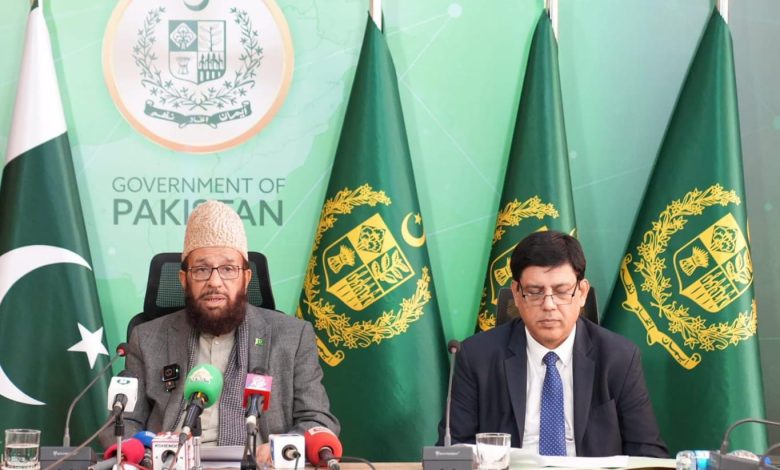
Hajj management earned international recognition when the Saudi Ministry of Hajj and Umrah awarded Pakistan an excellence award for arrangements during Hajj 2025. The Pakistani delegation received praise during a visit by the Saudi deputy minister to the Pakistan Hajj Mission in Makkah, and Prime Minister’s acknowledgement included a special shield presented to the Federal Minister for Religious Affairs. The ministry introduced digital services and transparency measures including the Pak Hajj mobile app, which provided pilgrims with guidance, training and logistical information, and reforms to the private Hajj scheme reduced complaints significantly.
Financial reforms delivered tangible results for pilgrims with refunds totaling 3.5 billion rupees returned to 75 percent of Hajj participants in 2025, averaging between 12,000 and 110,000 rupees per pilgrim. Registration for Hajj 2026 followed the Saudi timeline with 119,000 government and 60,000 private pilgrims registered, while training programs with audio-visual facilities were conducted at 147 sites nationwide to prepare pilgrims and maintain discipline and dignity abroad.
Improvements to pilgrimage and ziyarat management included a move away from the traditional salar system for Iraq and Iran visits toward a digital ZGO (Ziyarat Group Organizer) platform, with 221 companies registered so far out of 1,413 applications and plans to launch an online portal and mobile app. Umrah rules prepared under the Hajj and Umrah Act were submitted to the cabinet committee and contracts of 245 verified Umrah companies were published on the ministry website pending final rule approval.
Interfaith governance and minority protections were reinforced by the reconstitution of the National Ulema and Mashaykh Council, which met twice to recommend coordinated responses to extremism and hate speech. The Interfaith Harmony Policy and a Religious Tolerance Strategy were approved by the federal cabinet on 12 February 2025, and a National Commission for Minorities Act covering legal, financial and administrative matters was passed by Parliament on 1 December 2025, strengthening legal safeguards for minority communities.
Financial support for minorities and community outreach increased through allocations of 100 million rupees in fiscal 2024–25 and 85 million for 2025–26 for welfare and development projects. Thirty-two small development schemes were approved, 2,236 students received scholarships from 7,965 applications, and last fiscal year 1,528 eligible non-Muslim beneficiaries received 12 million rupees in assistance while the current year has seen over 440 beneficiaries receive more than 4 million rupees to date. Public observances of minority festivals at the presidential and prime ministerial residences and interfaith conferences in major cities underscored the state’s commitment to inclusion.
Institutional reforms aimed at efficiency reduced vacant posts by 60 percent to lower budgetary strain, introduced merit-based recruitment and procurement, and enforced regulatory frameworks for Hajj matters. A Web Evaluation Cell reviewed 74,700 online links and coordinated with the PTA for blocking offensive material while launching a social media awareness campaign to promote safe and responsible online discourse that supports Religious Harmony.
Operational resilience was demonstrated when the Kartarpur corridor was restored within 24 hours following floods attributed to cross-border water incidents, and high-level visits by the Prime Minister and a field marshal reaffirmed solidarity with Sikh pilgrims. Restoration of the unified moon sighting system at the central Ruet-e-Hilal Committee and renewed coordination with provincial and district committees ensured communal consensus for Ramadan and Eid observances.
Collectively, these reforms and programs in 2025 reflect a sustained push by the Ministry of Religious Affairs and Interfaith Harmony to institutionalize Religious Harmony through policy, digital transformation, pilgrimage excellence and targeted welfare for minority communities, reinforcing Pakistan’s message of tolerance and interfaith cooperation at home and abroad.