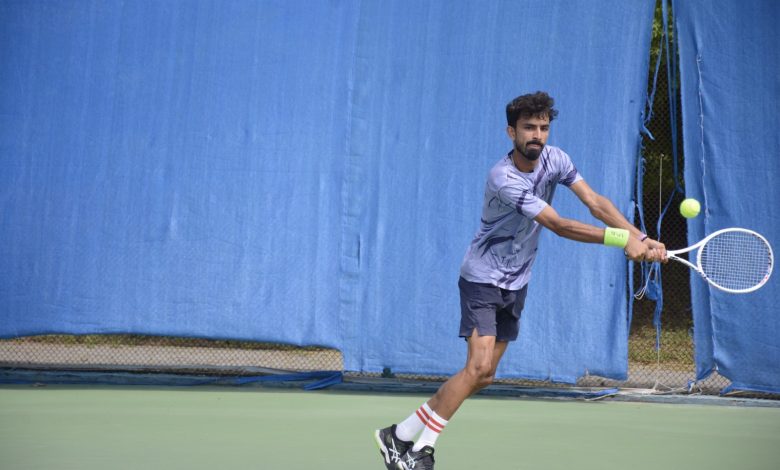
The Flair Travel ITF Men’s Futures M-15 (Leg-1) continued at the PTF Tennis Complex in Islamabad, organised in memory of Khawaja Iftikhar Ahmad to honour his lasting contribution to regional tennis. Mr. Iftikhar is recognised for being ranked No. 1 in pre-1947 India and remaining Pakistan’s top player for a decade after independence; he received the Presidential Medal Pride of Performance in 1964 from Field Marshal Ayub Khan.
The ITF Men Futures draw features 70 players from 23 countries, including Pakistan, Kuwait, Russia, Uzbekistan, Sweden, Australia, Malaysia, Great Britain, Italy, Lithuania, China, Turkey, Algeria, Canada, USA, Ireland, Poland, Hong Kong, Nepal, Greece, Saudi Arabia, Lebanon and Japan, bringing a strong international field to Islamabad.
Top seed Leo Borg of Sweden (ATP 483) and second seed Samir Hamza Reguig of Algeria (ATP 844) both produced notable wins on Day 2. Borg advanced with a 7-6(4), 6-3 victory over Pakistan’s Aqeel Khan, while Reguig edged veteran Andrei Kunitsyn 7-5, 2-6, 7-6(4). Turkey’s Mert Naci Türker also pulled off a dramatic three-set win in a tightly contested match decided by three tiebreaks.
Local players rose to the occasion as Pakistan kept its presence strong in the singles draw. Muhammad Shoaib defeated Italy’s Edoardo Cherie Ligniere 6-1, 6-3 with composed baseline play, and Barkatullah staged a comeback to beat countryman Yousaf Khalil 1-6, 6-4, 6-2, ensuring Pakistan retains momentum in the singles competition.
In Men’s Doubles action, the young Pakistani pairing of Abubakar Talha and Ahmad Nael Qureshi recovered after dropping the first set to beat Russia’s Egor Khotchenkov and Dmitrii Shirokii 5-7, 6-2, 10-5, showcasing resilience and improved coordination. Aqeel Khan and Barkat Khan delivered a dominant 6-0, 6-1 victory, while the Turkish duo Tugra Duran and Mert Naci Türker defeated Yousaf Khalil and Muhammad Shoaib 6-4, 6-4. Other doubles results included Essa Qabazard and Darrshan Suresh beating Arkhip Kozlov and Abdulaziz Usmonjonov 7-5, 6-3, and Adam Farag-Cao with Carl Holder overcoming Nikita Ianin and Andrei Kunitsyn 3-6, 7-6(3), 10-6.
The ITF Men Futures event in Islamabad continues over the coming days with the main draw progressing and emerging Pakistani talent drawing attention. Local fans have reason to follow the M-15 tournament as players vie for ranking points and valuable match experience at the PTF Tennis Complex.