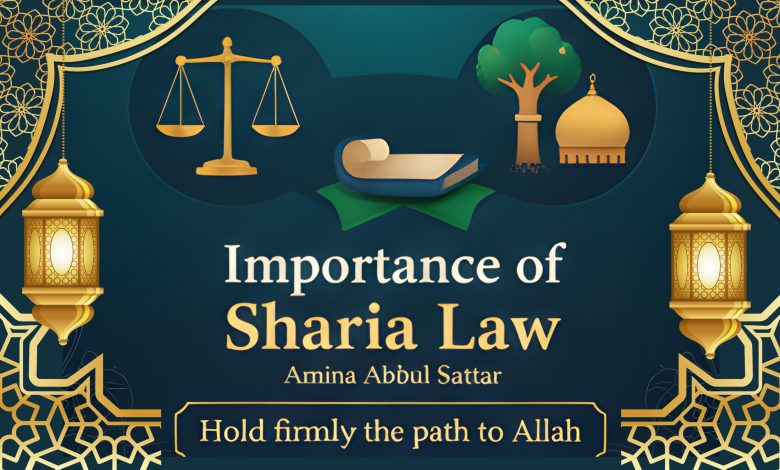
Importance of shria law
Amina Abdul sattar
When Hazrat Adam (A.S) came into the world, he had no awareness about anything. He did not know what life was or how to live it. Allah educated him about everything necessary for human life. Allah gave him a clear roadmap that guided him about essential life skills—what is needed for survival, how to find comfort, what to eat, and what to avoid. Adam and Hawwa (A.S) learned all of these matters through divine commandments.
Even when we are born, certain principles already apply to our lives. All these guidelines come from the Qur’an and Hadith, which are the primary sources of Sharia. Sharia is a flawless guide for humanity. It is not only a lifestyle but also a comprehensive code that teaches us how to behave at every stage of life. In the first revelation of the Qur’an, Allah instructed us to seek knowledge because learning is as important as food. To survive successfully, both food and knowledge are essential.
Before Islam, there were no proper rules for living. Our Prophet (S.A.W) came and illuminated the world with knowledge. Before the enforcement of Sharia, there was no peace. People lived in darkness and ignorance. The strong used to oppress the weak. Women were treated like property, and slaves had no rights. But Islam introduced a new standard of living. It granted women rights like inheritance, khula, and haq mahr.
Women had no dignity or rights. Some were buried alive at birth. Widows were not allowed to remarry and were forced to die with their husbands. Our Prophet (S.A.W) showed kindness and compassion through his treatment of his daughters, wives, and relatives. All these examples highlight the beauty of Sharia. Sharia is essential for us like oxygen—it is the foundation of our system.
Justice is a core element of our religion. Today the world has countless constitutions, and many principles originally came from Sharia. The concepts of fairness, equality, and balance were introduced by Islamic law. Islam does not allow superiority based on race, gender, or social class. After 1400 years, non-Muslims are still studying these values and shaping their laws based on equality.
Marriage is also an important part of Islamic teachings, and half of one’s faith lies in it. Islam does not only emphasize worship; it also provides comfort and emotional support. Husband and wife are garments for each other, providing peace and companionship. Parents must care for their children, and children must respect their parents. Kindness within a family brings reward in this world and the Hereafter. Islam encourages goodness not only towards relatives but also towards all human beings. A smile is considered a form of charity, and truthfulness is the heart of Islam.
Charity is a major part of our religion. According to Islamic law, zakat is compulsory for wealthy people. Though zakat becomes obligatory after one year, Islam has introduced many other forms of helping others. If a person eats comfortably while their neighbor sleeps hungry, they are sinful. Charity is not restricted to Muslims; helping non-Muslims in difficulty is also part of ethical conduct.
The concept of cleanliness also originates from Sharia. Those who maintain purity protect half of their faith. Personal hygiene and pure food are an essential part of Islam, and today the whole world recognizes their benefits.
Fasting and prayer are the main pillars of Islam. Allah repeatedly mentions them in the Qur’an. These worships teach us discipline. Today doctors recommend diet and physical activity, but Islam taught this discipline centuries ago. Many modern institutions such as the army, courts, police, and legal punishments have roots in Islamic principles.
The Qur’an is a complete book of motivation. It teaches us not to lose hope and to accept reality with patience. Many verses guide us to trust Allah during hardships. The Qur’an teaches us emotional control and anger management, which is crucial for mental peace. Our Prophet (S.A.W) was not only a spiritual leader but also a lawyer, doctor, scientist, psychologist, humanist, and motivational speaker. Today people spend huge amounts of money studying things that Islam has already taught.
People travel today for education and employment, but this is not new. Muslim ancestors travelled widely across the world. Even Hajj, the fifth pillar of Islam, involves travel and brings spiritual relief.
Today scientists highlight the importance of planting trees and warn against deforestation. The world now accepts the value of trees, which was already the culture of the Muslim golden era.
People sometimes ask why Muslim countries following Sharia are not successful. The truth is that they do not apply Sharia completely. Pakistan is an Islamic country, but scholars are divided, so true Sharia is not practiced perfectly. Afghanistan claims to implement Islamic law fully, but many of their actions do not reflect the real essence of Sharia. Sadly, no Islamic country today is practicing Sharia perfectly.
History proves that Muslims reached their golden age when they truly followed Islamic principles. They were honest, brave, and simple—qualities that are the essence of Islam. When Muslims left these values, their decline began. Today, we need to understand the wisdom behind Sharia. The first revelation instructed us to read, because without knowledge we cannot understand our religion. Sharia guides every aspect of our life—from day to night and from family matters to dealing with strangers. It not only gives rules but also ensures our well-being. Our festivals also promote generosity. On Eid-ul-Adha we distribute meat, and on Eid-ul-Fitr we share sweets.
Islam is a religion of peace and teaches harmony.
Sharia law is not just a system of punishments; it is a set of laws that protect human beings and guide them toward their rights. It brings fairness to uneven situations and gives hope even to barren lands. Now it is time to act according to Sharia laws. If we do not start living according to the Qur’an and Hadith, then God forbid, our name may be spoiled in this world. Even now, we are already facing the first major consequences.
“Hold firmly to the path of Allah “