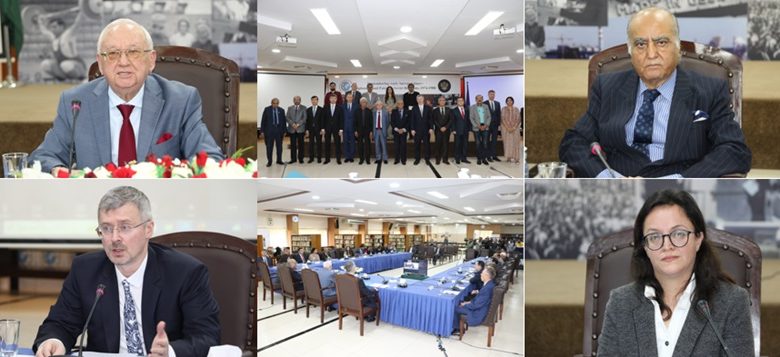
On March 30, 2026, the Institute of Strategic Studies Islamabad through its Centre for Strategic Perspectives, in partnership with the Embassy of the Russian Federation in Islamabad, convened a roundtable to remember Ambassador Sarvar Azimov and to examine Pakistan Russia relations during 1974–1980.
Dr Neelum Nigar opened the discussion by stressing the value of revisiting diplomatic legacies at a time of global instability and declining trust, noting that historical reflection can yield practical lessons for sustaining dialogue and cooperation in complex international contexts.
Ambassador Khalid Mahmood described the meeting as both commemorative and analytical, observing that Sarvar Azimov served in a period marked by Cold War tensions, regional realignments and strategic uncertainty. He underlined how Pakistan Russia relations have moved through phases from caution to gradual engagement, and said that understanding those phases is essential for shaping future policy.
Ambassador Albert P. Khorev highlighted Sarvar Azimov’s intellectual depth and diplomatic skill, recalling his role in strengthening ties in the 1970s as Pakistan under Zulfikar Ali Bhutto diversified its foreign policy. He pointed to Soviet-supported projects such as the Karachi Steel Mills and key thermal power plants as foundational to Pakistan’s industrial growth and economic self-reliance.
Speakers noted significant trade expansion between 1973 and 1980 and emphasised people-to-people and institutional cooperation, including Soviet technical assistance and the training of Pakistani engineers, which together built long-term foundations for collaboration and mutual understanding.
Ambassador Anvar S. Azimov, son of the late ambassador, offered personal reflections that underlined a constructive trajectory in Pakistan and Soviet relations despite external pressures. He recalled the Soviet Union’s early recognition of Pakistan and Moscow’s role in facilitating dialogue during the 1965–66 India–Pakistan conflict through the Tashkent process, and described his father’s approach of trust-building, respect and engagement across political divides.
During the discussion session, scholars explored how lessons from the 1970s can inform contemporary engagement in areas such as energy, connectivity and regional multilateral frameworks. Participants argued that historical reflection is not merely commemorative but can serve as a practical guide for navigating present and future challenges in bilateral and regional relations.
Speakers concluded on a forward-looking note, agreeing that while Pakistan Russia relations are today more positive, there is ample scope to revitalise the historical foundations of cooperation. The event ended with a vote of thanks and the presentation of mementos to the distinguished speakers.