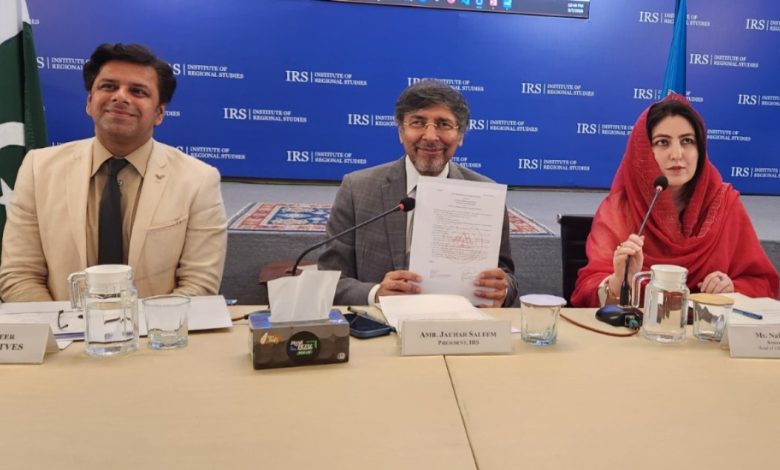
The Institute of Regional Studies Islamabad and the Institute of International Studies at Shandong University have signed a Memorandum of Understanding to deepen academic cooperation and expand institutional ties between Pakistan and China. The hybrid ceremony brought together senior scholars and researchers from both institutions and set a framework for joint conferences, collaborative publications, and scholar exchanges focused on young researchers and postdoctoral fellows.
Ambassador Jauhar Saleem and Professor Zhang Yunling signed the agreement, while Ms. Nabila Jaffer and Dr. Jamal Khan moderated the session. Executive Dean Li Yuan and Dr. Rizwan Naseer introduced their institutions and outlined research priorities that will shape the partnership, highlighting complementary strengths in regional studies, policy analysis, and international relations.
The MoU commits both sides to collaborative research programmes addressing regional and global issues, with emphasis on South-South cooperation, regional connectivity, and development. Planned activities include joint research projects, scholar exchanges, and coordinated policy dialogue to inform decision-makers in Pakistan and beyond. The agreement prioritises opportunities for early-career researchers and postdoctoral fellows to engage in sustained academic exchange.
In his remarks Ambassador Saleem described the partnership as a significant boost to longstanding intellectual ties and stressed the role of academic cooperation in advancing informed policy discourse. He called for stronger international collaboration to support sustainable peace, development, and climate security, noting Pakistan’s commitment to regional stability and constructive engagement amid heightened geopolitical tensions.
Professor Zhang welcomed the MoU as a “new start” for reinvigorating institutional collaboration and urged expanded scholarly exchange on bilateral and regional developments. Both institutions underscored the need to translate the agreement into results through evidence-based research and regular engagement, aiming to produce actionable insights on connectivity, economic cooperation, and regional resilience.
The joint session concluded with a substantive discussion on the evolving international environment, where participants reiterated their commitment to a rules-based and inclusive international order and to research that supports conflict prevention and durable development. The partnership is expected to strengthen Pakistan-China academic ties and deliver tangible benefits for researchers, policymakers, and institutions engaged in regional studies and higher education.