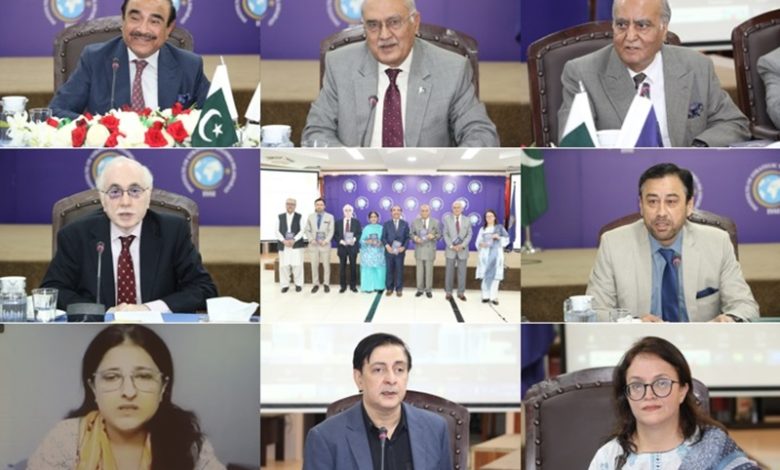
On May 12, 2026 the Institute of Strategic Studies Islamabad hosted the launch of The Third Dimension Policy Prism, authored by Ambassador G. R. Baluch. The event drew diplomats, academics, scholars and media, and featured a panel of discussants who examined the book’s implications for Pakistan’s external engagements and global strategic thinking.
Dr. Neelum Nigar, Director of the Centre for Strategic Perspectives at ISSI, opened the proceedings by expressing gratitude to Ambassador Baluch for choosing ISSI as the launch platform and commending his sustained contribution to discourse on strategic and policy affairs.
In his welcome remarks Ambassador Khalid Mahmood described the book as a timely scholarly intervention at a moment of profound international transformation. He noted that geopolitics today is shaped by intense strategic competition, technological disruption, economic realignments, climate risks and the expanding role of non-state actors, and he praised the Third Dimension for blending academic reflection with practical diplomatic insight.
Introducing his work, Ambassador G. R. Baluch observed that the contemporary world is engaged in a battle of narratives where ideas and discourse shape influence. He described the book as more of a conversation than a conventional text, one that traces how ideas move from pages into policy and public debate, and he thanked ISSI for facilitating the discussion.
Reviewers lauded the central premise of the Third Dimension which, according to General Khalid Naeem Lodhi, weaves ethics and humanity into traditional strategic frameworks. General Lodhi highlighted how the book’s five chapters survey diverse regions, Pakistan’s bilateral relationships, divisions within the Muslim Ummah, developments in the Middle East and the Gaza crisis while framing contemporary challenges through the three Cs of conflict, cooperation and consensus and underscoring the rising impact of technology on diplomacy and strategic competition.
Ambassador Masood Khalid called the book an accessible and valuable collection of essays that revisit longstanding geopolitical dilemmas and engage pressing contemporary concerns. He pointed to the analysis of South Asia, including India’s posture during Operation Sindoor, and the humanitarian and geopolitical dimensions of the Gaza conflict, noting the book’s effort to link global developments with Pakistan’s national interests.
Dr. Munawar Hussain emphasized the book’s focus on values, narrative formation and ideology as drivers of international behaviour, and he argued that the work makes a compelling case for multilateral engagement over unilateral approaches. Dr. Shazia Khalid Cheema underscored the book’s attention to symbolic, moral, psychological and cultural dimensions that shape political identities through media, stories and historical memories, and she appreciated the author’s shift from regional analysis to reflections on Pakistan’s internal educational and institutional challenges.
Farukh Pitafi noted the book’s dual appeal to diplomats and academics, praising its conceptual depth and readable structure across thematic chapters on South Asia, the Middle East, great powers and global politics. He highlighted the humanistic threads on education and artificial intelligence that demand reflection alongside the dense ideas presented. The launch concluded with a formal unveiling of the book and presentation of mementos to the speakers.