A landmark national study presented in Islamabad has redefined the scale of Pakistan’s rooftop energy movement, showing more than 33 gigawatts of distributed solar capacity across the country. The findings, released by the Policy Research Institute for Equitable Development (PRIED), contrast sharply with previously reported figures and underline the rapid, citizen-led adoption of rooftop solar technology.
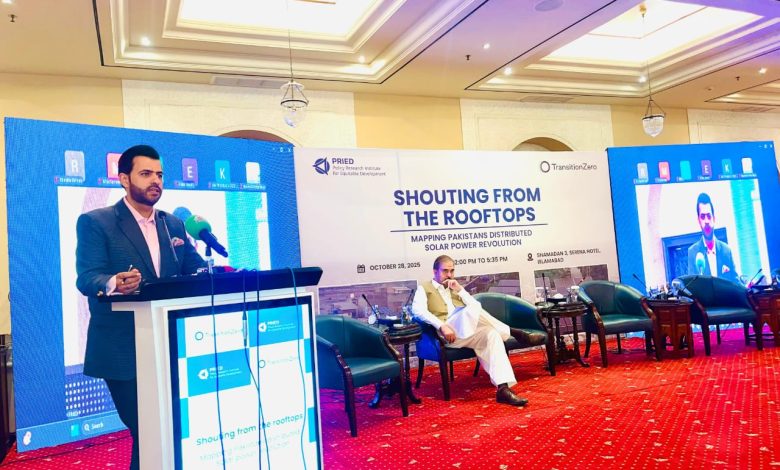
Parliamentary Secretary for Information & Broadcasting Barrister Danyal Chaudhry, who also serves as Secretary of the Parliamentary Forum on Energy & Economy, welcomed the study and said the results are a wake-up call for policy makers. He noted that the official count of 175,000 net-metered systems understates the reality on the ground and that distributed solar now rivals the nation’s peak grid demand, driven largely by households, businesses and local innovators.
While praising this grassroots momentum, Barrister Chaudhry urged a policy shift to ensure equitable access to distributed solar. He emphasized that the next phase must focus on innovative financing, supportive regulations and targeted programs to extend solar access to farmers, small enterprises and low-income households so the benefits are not limited to wealthier segments of society.
The launch event in Islamabad was opened by Muhammad Badar Alam, CEO of PRIED, with detailed presentations from PRIED researchers Manzoor Ahmed, Muqaddas Ashiq and Rimsha Rehan. A technical satellite mapping analysis was delivered by Max Santos, Data Scientist at Transition Zero, which helped validate the scale and distribution of rooftop installations across provinces.
Experts and agency representatives took part in a comprehensive panel discussion, including Syed Faizan Ali Shah, Independent Energy Consultant; Ather Rehman, Deputy Director at NEPRA; Arqam Ilyas from LESCO; Umer Iftikhar from PESCO; Hasnat Khan, Vice Chairman of the Pakistan Solar Association; Shaheera Tahir of PRIED; Salman Gul and Saeed Ahmed from ISMO; Aqeel Jafeeri, D.G. International Cooperation/Policy at PPIB; Uner Khan, Joint Director Planning and Procurement at PPIB; and Asad Ullah Chaudhary from NTDC.
Sher Ali Arbab, co-convener of the Parliamentary Forum on Energy & Economy, and Asif Khan, Member of the Provincial Assembly of Khyber Pakhtunkhwa, also addressed the gathering. The ceremony concluded with remarks from Dr. Shezza Mansab Ali Khan Kharal, Minister of State on Climate Change, who stressed the need for coordinated federal and provincial action to harness the distributed solar opportunity for climate and development goals.
The PRIED report and the event have catalyzed renewed discussion on how to mainstream distributed solar into Pakistan’s energy planning, balance grid stability with decentralised generation, and design subsidy and financing models that promote energy equity while addressing circular debt and long-term system resilience.