A Japan-funded emergency project led by the Food and Agriculture Organization of the United Nations (FAO) has brought significant relief to flood-stricken farming and livestock communities in Pakistan’s Balochistan and Sindh provinces. The initiative restored food production, improved nutrition, and boosted long-term resilience for over 74,000 households, following the devastating floods of 2022.
Supported by a contribution of USD 6.48 million from the Government of Japan, the FAO project delivered a combination of agricultural support, livestock protection, and targeted assistance to the most vulnerable communities, including female-headed families. In total, more than 520,000 people benefited from the coordinated efforts.
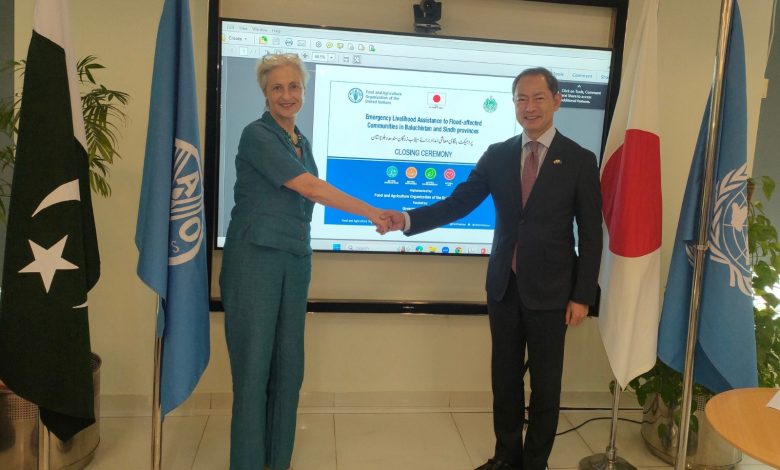
A project completion event was held at FAO’s Islamabad premises to highlight the key achievements and recognize Japan’s crucial support. The gathering was attended by the Ambassador of Japan to Pakistan, H.E. Mr. Akamatsu Shuichi, FAO Representative Florence Rolle, and senior national and provincial partners. Ambassador Akamatsu reaffirmed Japan’s commitment to human security in development cooperation, emphasizing the practical and sustainable agricultural support offered to help Pakistan’s flood victims rebuild their lives.
The agricultural component of the project included the distribution of seeds and fertilizers, along with training for families to restart food production. Over 14,000 households received inputs for vegetable and field crop cultivation, leading to the rehabilitation of 1,500 hectares of farmland. Farmers were able to cultivate a diverse range of crops—including wheat, rice, maize, okra, brinjal, and tomatoes—which improved both food security and household incomes.
To support livestock-owning families, the FAO provided animal feed, mineral blocks, poultry, small ruminants, and constructed animal shelters. A mass vaccination campaign covered more than 629,000 animals, benefiting 35,000 households. Special attention was paid to female-headed families, who received livestock and poultry packages, as well as training in animal care, enabling them to diversify and stabilize their sources of income.
FAO Representative Florence Rolle underlined the transformative impact of the project, noting that many rural families had lost nearly everything in the floods and have now regained their capacity to produce food and strengthen their resilience. The initiative was implemented in collaboration with Pakistan’s Ministry of National Food Security and Research, disaster management authorities, and non-governmental partners.
Further, the project contributed to building local capacity in climate-smart agriculture, food security planning, and livestock management, laying the groundwork for stronger and more resilient rural communities in the face of future challenges.