**Pakistan and Kenya Seek to Deepen Agricultural and Trade Cooperation**
The governments of Pakistan and Kenya are advancing discussions to enhance bilateral cooperation, focusing on the agricultural and trade sectors. Senior officials from both countries have identified new avenues for collaboration, highlighted by upcoming high-level meetings and proposed institutional agreements aimed at expanding trade and knowledge exchange.
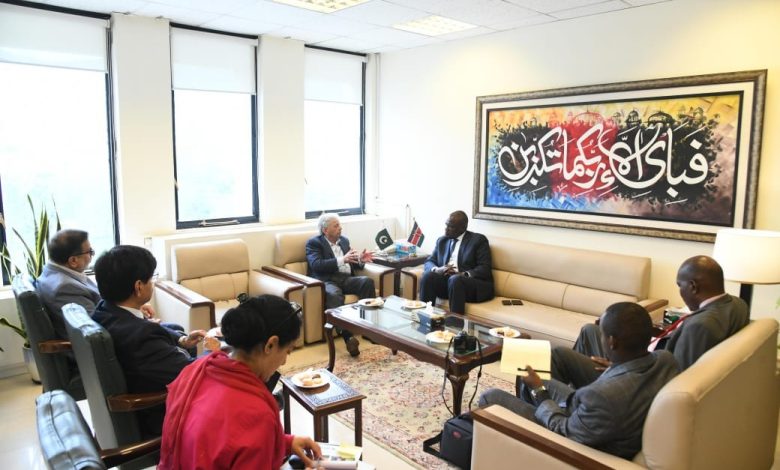
During a recent meeting, Pakistan’s Federal Minister for National Food Security and Research, Rana Tanveer Hussain, welcomed Lt. Gen. (Rtd.) Peter Mbogo Njiru, Kenya’s High Commissioner to Pakistan. Minister Hussain emphasized Pakistan’s commitment to reinforcing agricultural relations, noting that bilateral trade between the two nations currently stands at approximately USD 1 billion. Pakistan mainly exports rice, cotton, and seeds to Kenya, while importing tea and other commodities valued at around USD 350 million. Both sides recognized significant untapped potential, especially in diversifying agri-based trade.
High Commissioner Njiru expressed Kenya’s strong interest in institutional collaboration and announced his forthcoming visit to the Pakistan Agricultural Research Council (PARC) to explore joint research and innovation initiatives. Minister Hussain pointed to PARC’s extensive network of 44 specialized research institutes and expressed Pakistan’s readiness to partner with Kenya in areas such as seed development, livestock, cotton production, and agricultural mechanization.
The two countries are expected to finalize a Memorandum of Understanding (MoU) on agricultural and trade cooperation as part of the upcoming Pakistan-Kenya Joint Trade Committee meeting set to be held in Islamabad. Minister Hussain stated that this meeting would be an important platform to institutionalize cooperation and cement agreements designed to expand agricultural trade and facilitate knowledge sharing between the two countries.
In addition to existing trade, Minister Hussain acknowledged Kenya’s interest in exporting avocados, mangoes, flowers, and tea to Pakistan, with particular emphasis on the quality and competitive pricing of Kenyan avocados. He reiterated Pakistan’s willingness to diversify its import portfolio from Kenya, underscoring how the two countries’ agricultural sectors can complement each other.
Another topic discussed was the role of the expatriate Pakistani community in Kenya. The High Commissioner highlighted that between 2,000 to 3,000 Pakistanis are contributing to Kenya’s hospitality, banking, automobile trade, and development sectors, notably through organizations like the Aga Khan Foundation. Minister Hussain welcomed this contribution and noted the importance of people-to-people ties in strengthening bilateral relations.
The dialogue also featured Kenya’s ongoing cooperation with Pakistani institutions such as the National Agriculture Foundation and the National Textile University in Faisalabad. Minister Hussain called for expanding these collaborations to include joint ventures, research partnerships, and the transfer of technology in fields like textiles, leather, and agricultural processing.
The High Commissioner further thanked Pakistan for its support in defense training, citing the training of numerous Kenyan Army and Navy officers at prestigious Pakistani institutions. He also acknowledged Minister Hussain’s participation in the recent Kenyan Independence Day celebrations as a gesture of mutual respect and friendship.
Both sides reaffirmed their commitment to building on the long-standing diplomatic relationship, which dates back to 1964, and agreed to reinvigorate institutional linkages and sectoral cooperation. The Ministry of National Food Security and Research reiterated its dedication to deepening Pakistan’s agricultural diplomacy and international partnerships under the leadership of Minister Rana Tanveer Hussain.