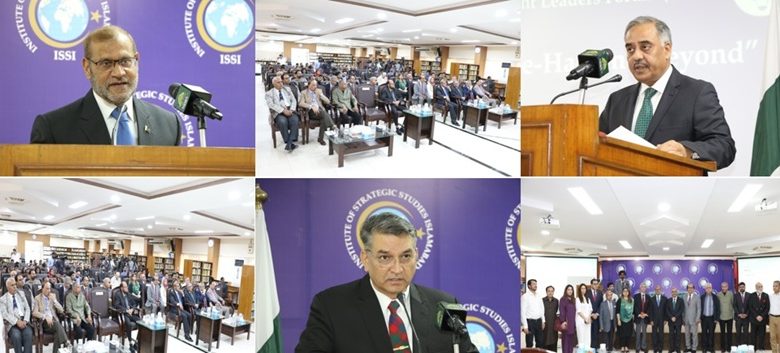
Former Chief of Air Staff, Air Chief Marshal (Retired) Sohail Aman, addressed the Institute of Strategic Studies Islamabad (ISSI) as part of the organization’s Thought Leaders Forum, providing critical insights on Pakistan’s recent defense posture against India and the region’s future security landscape. The session, titled “Marka-e-Haq and Beyond,” examined how Pakistan’s military, governmental leadership, and public unity enabled the nation to repel Indian aggression and maintain its sovereignty.
At the opening of the event, ISSI Director General Ambassador Sohail Mahmood praised “Marka-e-Haq” as a significant demonstration of Pakistan’s resolve. He highlighted that the crisis erupted due to provocative actions initiated by the Indian government, influenced by ideology, domestic politics, and a belief in military superiority. Ambassador Mahmood explained that during the conflict in May 2025, Pakistan achieved successes across diplomatic, military, and informational fronts, notably with the Pakistan Air Force downing at least six Indian fighter jets. He emphasized the effectiveness of Pakistan’s targeted response, dubbed “Operation Bunyan-um-Marsoos,” which marked a shift to integrated, multi-domain operations involving drones, cyber capabilities, and joint command. However, he cautioned that the situation with India remains unstable, warning that India persists with operations under different forms and continues to harbor dangerous notions about limited war under the nuclear threshold. For sustained peace, he called for continued vigilance, modernization of military capabilities, greater self-reliance, and proactive diplomacy.
During his address, Air Chief Marshal (Retired) Sohail Aman argued that India continues to pursue conflict despite global desires for peace, mistakenly assuming Pakistan would not respond to provocations. He detailed how Pakistan’s decisive actions proved otherwise, with the success of “Marka-e-Haq” and “Operation Bunyan-um-Marsoos” demonstrating transformative advances in multi-domain warfare. Aman directly rejected India’s claims of facing a combined China-Pakistan force during the conflict, calling it an unfounded attempt to save face. He pointed out that the technologically advanced and agile Pakistan Air Force managed to outperform a numerically superior adversary. While nuclear deterrence held strong during the crisis, Aman expressed concern over India’s belief in the possibility of a limited conventional war, warning that any such miscalculation could risk uncontrollable escalation. He stressed the necessity of maintaining clear boundaries and reiterated that enduring peace in the region depends on dialogue, diplomacy, and resolution of core disputes such as Kashmir. Prioritizing economic development, stability, and regional connectivity was highlighted as essential for South Asia’s future.
Earlier, Dr. Talat Shabbir, Director of the China-Pakistan Study Centre, framed the discussion’s timeliness and commended the collective effort of Pakistan’s leadership, institutions, and citizens during the conflict.
The event concluded with an engaging question-and-answer session, allowing participants to explore issues related to regional security, advancements in warfare, and strategies for ensuring deterrence. Air Chief Marshal Sohail Aman was presented with a memento in appreciation of his contributions. The gathering brought together experts, diplomats, and policy-makers for a comprehensive discussion on sustaining peace and stability in South Asia.