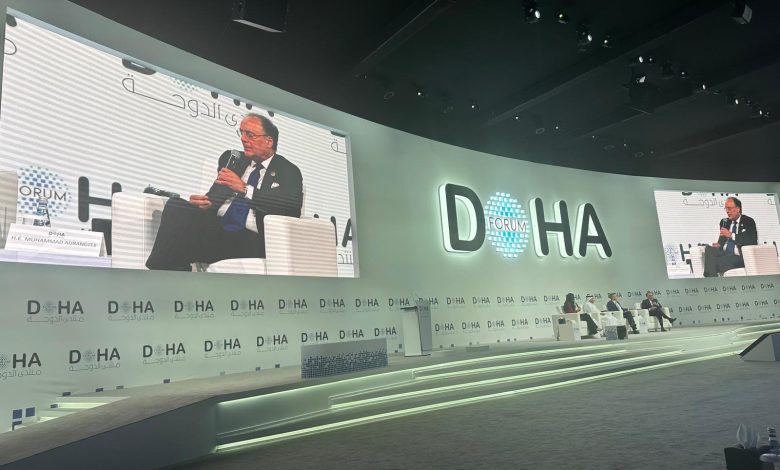
At the 23rd Doha Forum Federal Minister for Finance and Revenue Senator Muhammad Aurangzeb took part in a high-level panel convened by the Doha Forum, the Ministry of Finance of Qatar and the IMF to discuss global trade tensions and policy responses in the MENA region. The session focused on how countries can manage rising uncertainty, shifting supply chains and new prospects for cooperation and diversification.
Senator Aurangzeb outlined Pakistan’s progress in macroeconomic stabilisation under the IMF programme and described ongoing structural reforms in taxation, the energy sector, state-owned enterprises and private-sector development. He emphasised Pakistan’s return to primary and current account surpluses, underpinned by robust remittance flows of about USD 18–20 billion annually from the MENA and GCC region, as a key element of fiscal resilience.
The minister highlighted Pakistan’s constructive engagement with the United States on tariff matters, securing a favourable 19 percent tariff on key textile exports while accelerating product and market diversification. He also flagged the rapid rise in IT services exports, expected to reach USD 4 billion this year, and growing trade links with Gulf and Central Asian economies as important drivers of export-led recovery.
While welcoming progress, Senator Aurangzeb warned that climate change and demographic pressures remain Pakistan’s most significant long-term challenges, citing this year’s flooding that knocked about 0.5 percentage points off GDP growth as a stark reminder of vulnerability to extreme weather.
Qatar’s Finance Minister H.E. Ali Bin Ahmed Al Kuwari praised Pakistan as a close partner and underscored deep bilateral trade ties in LNG, agriculture and textiles. He announced that the new GCC–Pakistan Free Trade Agreement, the GCC’s first FTA in many years, will expand trade flows and strengthen long-term cooperation. He also expressed strong interest in partnering with Pakistan on AI and digital technologies, noting Pakistan’s expanding talent base.
IMF Deputy Managing Director Bo Li commended Pakistan’s reform momentum and resilience-building efforts, announcing additional IMF support of USD 1.3 billion under the Resilience and Sustainability Facility to strengthen fiscal, financial and climate resilience.
Senator Aurangzeb reiterated Pakistan’s balanced and pragmatic approach to major partners, highlighting progress on CPEC Phase 2.0 while noting emerging collaboration with the United States in minerals, AI, blockchain and digital governance. He pointed to the potential of Pakistan’s youth and the country’s position as one of the world’s largest freelancer communities to benefit from upskilling in advanced technologies.
Following the panel, a bilateral meeting between Senator Aurangzeb and H.E. Al Kuwari resulted in agreements to deepen economic cooperation, maximise opportunities under the new GCC–Pakistan FTA and strengthen long-term energy collaboration. Both ministers discussed advancing joint initiatives in AI, digital infrastructure and skills development and agreed to formalise mechanisms to support cooperation in trade diversification, technology, climate resilience and investment facilitation. The discussions signalled renewed momentum and confidence that Pakistan–Qatar relations are entering a new phase of strategic growth.