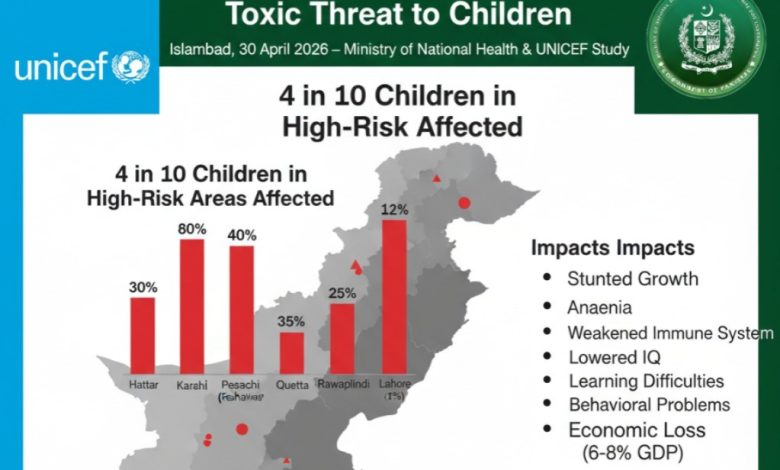
A joint study by the Ministry of National Health Services, Regulations and Coordination and UNICEF has found that four in ten children aged 12–36 months living in high‑risk areas of seven Pakistani cities carry lead in their blood. The research sampled more than 2,100 children in Haripur, Islamabad, Karachi, Lahore, Peshawar, Quetta and Rawalpindi and revealed stark local differences in lead exposure.
Children in Hattar, Haripur, were the most affected, with 88 percent recorded as having high blood lead levels while just 1 percent of children sampled in Islamabad showed high levels. The findings underscore the uneven geography of lead exposure across urban and industrial zones and the urgent need for targeted local interventions.
Lead exposure has well‑documented impacts on child health and development. It can stunt growth, cause anaemia, weaken the immune system and damage developing brains by lowering IQ, reducing attention span and impairing memory. There is no safe level of exposure for children, who absorb lead more readily than adults and face lifelong consequences from early exposure.
The study identified likely sources of contamination based on global evidence, including industrial emissions, informal battery recycling, lead‑based paints, contaminated spices and food, and traditional cosmetics. Persistent risks are linked to gaps in regulatory enforcement, limited monitoring and low public awareness, which allow hazardous practices to continue in high‑risk communities.
Muhammad Aslam Ghauri, Federal Secretary Health at the Ministry of National Health Services, said the government views protecting children from lead exposure as a national priority and is committed to strengthening surveillance, enforcing standards and integrating prevention into child health programmes across Pakistan.
Pernille Ironside, UNICEF Representative in Pakistan, warned that children are uniquely vulnerable and that action must be taken now because the harmful effects of lead are irreversible. The report and high‑level consultations highlighted priority actions: a national action plan to remove lead from high‑risk products, blood lead surveillance built into child health services, stronger public education, a government‑led multi‑sectoral task force and improved evidence to guide policy and investments.
Global estimates suggest the burden in Pakistan could be far higher, with up to eight in ten children potentially affected, and the long‑term economic impact of lead exposure estimated at 6–8 percent of GDP, or roughly USD 25–35 billion annually. Stakeholders at the launch agreed that eliminating childhood lead poisoning will require coordinated regulatory reform, enforcement and sustained investment in prevention.
To fill current evidence gaps, a nationally representative survey of children and pregnant women is planned later this year to map the full scale of lead exposure and inform targeted interventions. The launch coincided with a mission by the Partnership for a Lead‑Free Future to support technical exchange and partnership building aimed at eliminating childhood lead poisoning in Pakistan by 2040.
Policymakers, health professionals and communities will need to act together to reduce lead exposure, protect child health and prevent lifelong learning and development losses that affect families and the national economy.