World Population Day 2025: Health Minister Mustafa Kamal Issues National Call to Action Amid Alarming Growth Trends
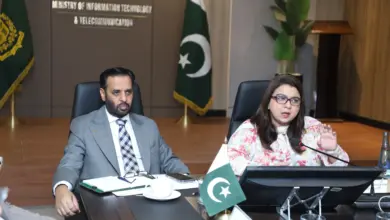
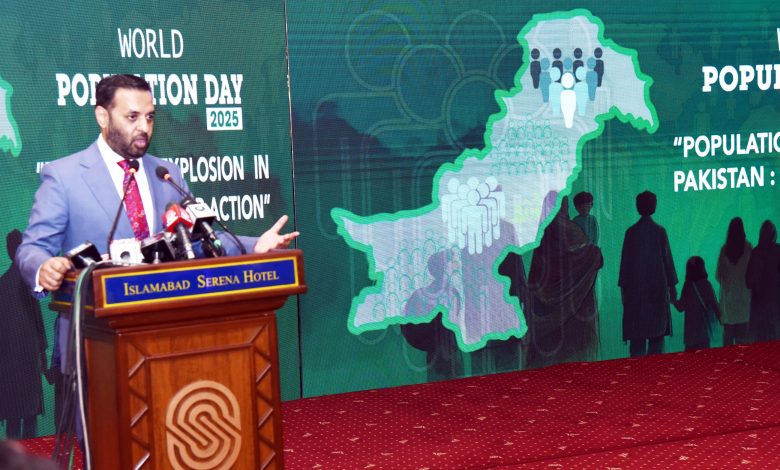
Islamabad: In a landmark address marking World Population Day 2025, Federal Minister for Health Syed Mustafa Kamal delivered a powerful and comprehensive speech highlighting the gravity of Pakistan’s population crisis and calling for unified, cross-sectoral reforms to secure the country’s future. The high-level national event, organized by the Ministry of National Health Services, brought together senior political leaders, religious scholars, federal ministers, and international partners in Islamabad to address the multifaceted challenges of population growth.
Minister Kamal began by affirming that the population issue is not a partisan or political concern, but a matter of national survival. Stressing the importance of collective ownership, he personally invited leaders from all political parties to participate in the event. He emphasized that such a challenge cannot be tackled by a single ministry, party, or province—it requires national unity.
The minister cited alarming statistics: Pakistan’s fertility rate stands at 3.6—the highest in the region—and the population is growing by 2.5% annually, adding over 6 million people every year. “That’s more than the entire population of New Zealand being added to our country each year,” he said. “We don’t have the resources to support those who are already here—how can we possibly accommodate millions more?”
Linking demographic pressures to real-world consequences, Kamal drew attention to over 25 million children currently out of school, a healthcare system on the brink of collapse, and 40% of children suffering from stunted growth and malnutrition. “Our hospitals resemble political rallies,” he observed. “Doctors face queues of 250 patients a day when they are only meant to see 30 to 35.”
He challenged the very foundations of Pakistan’s health framework, stating that the country operates a “sick care system” rather than a true health care system. Preventive medicine, he argued, has been neglected, with waterborne diseases being the most devastating result. “Sixty-eight percent of our diseases stem from unsafe water,” he said. “We flush our sewage away without treatment, and it ends up in our drinking water. From Gilgit-Baltistan to Karachi, the sewage system is broken. We are making our own children sick.”
The minister further criticized the financial incentives embedded in Pakistan’s National Finance Commission (NFC) Award, which allocates 82% of funds based on population. This, he said, creates a harmful incentive for provinces to increase their population counts. Kamal proposed a restructured formula—50% based on population and the remaining 32% allocated as an incentive to provinces that successfully reduce fertility rates. This idea was echoed and expanded upon by Federal Minister for Planning Ahsan Iqbal, who announced a new high-level Steering Committee to revisit population parameters within the NFC framework.
Reaffirming his ministry’s commitment to accessible family planning, Kamal called for the removal of the 18% GST on contraceptive products and encouraged local manufacturing to ensure availability and affordability. “Families want to plan—but they need access. We must act decisively to remove these barriers.”
The event also highlighted strong religious endorsement for responsible family planning. Renowned Islamic scholar Mufti Zubair clarified that Islamic teachings support protecting maternal and child health through planned parenting. “This is not against religion. It is in line with Islam’s values of mercy, responsibility, and health.”
Finance Minister Muhammad Aurangzeb stressed that population growth undermines national resources, economic development, and social equity. He committed to integrating demographic factors into fiscal planning. Speaker of the National Assembly Raja Pervaiz Ashraf commended the Ministry’s efforts and called for a multi-party legislative response. Senior political leader Khursheed Shah urged Pakistan to learn from countries like Bangladesh, where effective population control has boosted economic and educational outcomes.
UNFPA Country Representative Luay Shabaneh pledged international support for Pakistan’s reproductive health and family planning programs, while KP representative Liaqat Ali Khan proposed a dedicated Population Fund and urged enhanced demographic planning up to 2050.
Dr. Tariq Fazal Chaudhary, Minister for Parliamentary Affairs, called for greater investment in youth, infrastructure, and civic development, highlighting the opportunity presented by Pakistan’s demographic dividend—if managed wisely.
In his concluding remarks, Kamal reiterated that Pakistan’s future depends on how it responds to this urgent crisis. “No economic plan, no development framework, no government can function if we don’t control this. We must act now.”
The event closed with the Health Secretary’s commitment to evidence-based, inclusive, and sustained strategies, affirming that managing population growth is not only a development priority—it is a national imperative.